Overview
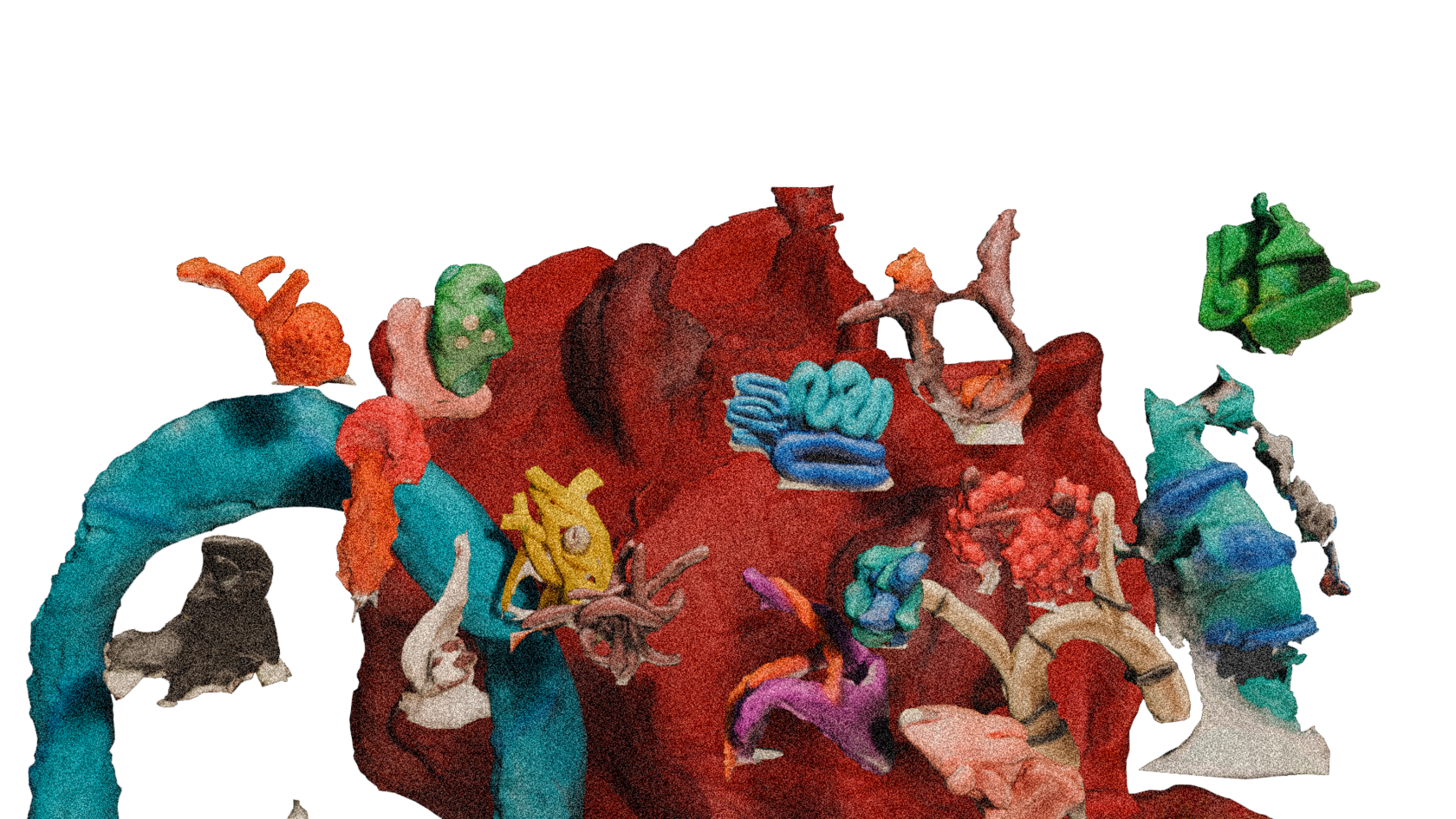
A mobile "not-game" controlled through the phone's gyroscope, where the player navigates a small figure through a world populated by creatures made from 3D-scanned plasticine. Each creature speaks in phrases that translate a philosophical framework about bodies, technology, and calibration into human language.
Tools: Unity, accelerometer/gyroscope input, 3D scanning
Context: Independent work, 2026
A mobile "not-game" controlled through the phone's gyroscope, where the player navigates a small figure through a world populated by creatures made from 3D-scanned plasticine. Each creature speaks in phrases that translate a philosophical framework about bodies, technology, and calibration into human language.
Tools: Unity, accelerometer/gyroscope input, 3D scanning
Context: Independent work, 2026
Concept
Concept Calibration asks what happens when a body and a technological system learn to move together. The player controls a character not through buttons but through the orientation of their own hand – tilting, steadying, correcting.
The creatures the player encounters do not explain the rules. They speak from inside the system – about drift, measurement, stability, and the small continuous work of remaining upright. Their language is ironic and intimate, because the process they describe is not abstract: it is happening in the player's wrist right now.
The central idea, drawn from Gilbert Simondon, is that calibration is never one-directional. The technology adjusts to the body; the body adjusts to the technology. What emerges is not control, but a self-sustaining system – one that neither party fully authors.
The creatures the player encounters do not explain the rules. They speak from inside the system – about drift, measurement, stability, and the small continuous work of remaining upright. Their language is ironic and intimate, because the process they describe is not abstract: it is happening in the player's wrist right now.
The central idea, drawn from Gilbert Simondon, is that calibration is never one-directional. The technology adjusts to the body; the body adjusts to the technology. What emerges is not control, but a self-sustaining system – one that neither party fully authors.

Framework
The project draws on three thinkers working at the intersection of technology, body, and action.
Gilbert Simondon provides the core: the technical object is not a passive tool but a process. Stability is not a final state but a temporary resolution of tensions. The machine does not work in the world – it works with it, and the environment becomes part of what the machine is.
Bernard Stiegler adds the question of translation: continuous bodily movement is grammatized – broken into discrete, technically readable elements. The hand does not enter the system as it is; it arrives as angle, delay, deviation, threshold. Something is always lost or smoothed in the conversion.
Yuk Hui frames the political dimension: technology is never neutral. Every system creates an ontology – decides what counts as movement, what counts as error, what counts as acceptable input. To pass through the interface, the body must first become legible to it.
Together, these form the question the game plays out: not "who controls whom" but how a shared condition of action is produced between a body, a device, and a system of measurement.
The project draws on three thinkers working at the intersection of technology, body, and action.
Gilbert Simondon provides the core: the technical object is not a passive tool but a process. Stability is not a final state but a temporary resolution of tensions. The machine does not work in the world – it works with it, and the environment becomes part of what the machine is.
Bernard Stiegler adds the question of translation: continuous bodily movement is grammatized – broken into discrete, technically readable elements. The hand does not enter the system as it is; it arrives as angle, delay, deviation, threshold. Something is always lost or smoothed in the conversion.
Yuk Hui frames the political dimension: technology is never neutral. Every system creates an ontology – decides what counts as movement, what counts as error, what counts as acceptable input. To pass through the interface, the body must first become legible to it.
Together, these form the question the game plays out: not "who controls whom" but how a shared condition of action is produced between a body, a device, and a system of measurement.
Process
The creatures were sculpted from plasticine and scanned using RealityScan. Scanning took an entire day — the app is not optimized for small objects and repeatedly failed, requiring the scans to be redone. The gap between what the hand made and what the system could read was, in that sense, already part of the project's subject matter.
The gyroscope input and physics simulation were developed with AI assistance, as the code required goes beyond my current independent capacity. This felt like an honest reflection of the project's own argument: authorship here is also distributed, also a calibration between what I can do and what the tool makes possible.
One technically new area was shader work – specifically making objects become transparent when they block the player's view. This required going further into materials and rendering than I had before.
What remains to be done: the game currently has no sound, and there are performance issues that could be addressed through retopology and light baking. Physics optimization would also improve the experience, but that sits beyond what AI assistance and my current skills can resolve together – for now.
The gyroscope input and physics simulation were developed with AI assistance, as the code required goes beyond my current independent capacity. This felt like an honest reflection of the project's own argument: authorship here is also distributed, also a calibration between what I can do and what the tool makes possible.
One technically new area was shader work – specifically making objects become transparent when they block the player's view. This required going further into materials and rendering than I had before.
What remains to be done: the game currently has no sound, and there are performance issues that could be addressed through retopology and light baking. Physics optimization would also improve the experience, but that sits beyond what AI assistance and my current skills can resolve together – for now.
