Overview
Four works created for "Pobegi" (Roots), an independent horizontally self-organized contemporary art festival held in a forest outside Moscow. The festival's eighth edition, titled "Slyot" (Rally), was built around the theme "Art as a Tumbleweed" – exploring movement, ecosystem change, and the temporality of artistic forms.
All works were exhibited by art union 2.23*, a small art community co-founded in August 2025 that works across physical and digital media, creating experiences at the intersection of science, emotion, and technology.
Context: Pobegi Festival "Slyot", Moscow region forest, August 2025. Collaborative project with art union 2.23*
Four works created for "Pobegi" (Roots), an independent horizontally self-organized contemporary art festival held in a forest outside Moscow. The festival's eighth edition, titled "Slyot" (Rally), was built around the theme "Art as a Tumbleweed" – exploring movement, ecosystem change, and the temporality of artistic forms.
All works were exhibited by art union 2.23*, a small art community co-founded in August 2025 that works across physical and digital media, creating experiences at the intersection of science, emotion, and technology.
Context: Pobegi Festival "Slyot", Moscow region forest, August 2025. Collaborative project with art union 2.23*
Double-Sight
Projection mapping – projector, photograph, wood
A site-specific projection of a photograph of a tree onto the same tree, exploring virtuality through the act of duplication and return.
Inspired by Joseph Kosuth's "One and Three Chairs", the work shifts focus toward the phenomenology of image and place – questioning what an object gains or loses in its virtual double, whether multiplicity can form a whole, and how light and perspective shape collective perception of reality.
A site-specific projection of a photograph of a tree onto the same tree, exploring virtuality through the act of duplication and return.
Inspired by Joseph Kosuth's "One and Three Chairs", the work shifts focus toward the phenomenology of image and place – questioning what an object gains or loses in its virtual double, whether multiplicity can form a whole, and how light and perspective shape collective perception of reality.


Interfer-trace
Interactive installation – laptop, 3D cinema glasses, transparent film, rope
The installation explores the interrelation between collective memory, communication, and ecology – questioning the boundary between the visible and the invisible in shared experience.
Viewers wore diffraction glasses and looked at a laptop screen through layers of transparent film of varying density. They were invited to leave marks on the plastic surface – traces of presence visible only through the glasses, where they appeared as iridescent patterns.
From an ecological perspective, plastic becomes an inseparable part of this memory: a carrier of human traces that we cease to notice, even as it continues to preserve our presence.
My role: sole author – concept, production, and execution.
The installation explores the interrelation between collective memory, communication, and ecology – questioning the boundary between the visible and the invisible in shared experience.
Viewers wore diffraction glasses and looked at a laptop screen through layers of transparent film of varying density. They were invited to leave marks on the plastic surface – traces of presence visible only through the glasses, where they appeared as iridescent patterns.
From an ecological perspective, plastic becomes an inseparable part of this memory: a carrier of human traces that we cease to notice, even as it continues to preserve our presence.
My role: sole author – concept, production, and execution.


Air Box
Holographic installation – cardboard, glass, 3D scans, 3D animation
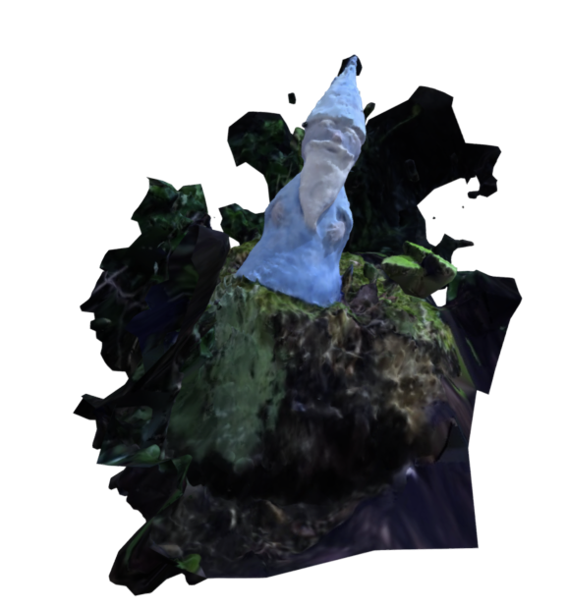
A collective "air box" where illusory objects are simultaneously enclosed and freed. Inside, 3D-scanned shapes from the festival's environment rotate and persist: detached from their original space, yet preserved within a shared visual archive. Each participant could bring their own object to be woven into this expanding holographic memory.
My role: author of the concept and main executor – responsible for both the visual form and the content.
A collective "air box" where illusory objects are simultaneously enclosed and freed. Inside, 3D-scanned shapes from the festival's environment rotate and persist: detached from their original space, yet preserved within a shared visual archive. Each participant could bring their own object to be woven into this expanding holographic memory.
My role: author of the concept and main executor – responsible for both the visual form and the content.


About 2.23*
2.23* is a science art collective co-founded in August 2025.
We create experiences that unite science, emotion, and technology – transforming shared observation into collective presence. Working across physical and digital media, we explore hidden contexts of everyday processes through XR, sound, mapping, and interactive installations. Each project is a felt experience materialized into an event that happens to everyone involved.
Since founding, the collective has participated in several exhibitions and festivals, starting with "Pobegi".
2.23* is a science art collective co-founded in August 2025.
We create experiences that unite science, emotion, and technology – transforming shared observation into collective presence. Working across physical and digital media, we explore hidden contexts of everyday processes through XR, sound, mapping, and interactive installations. Each project is a felt experience materialized into an event that happens to everyone involved.
Since founding, the collective has participated in several exhibitions and festivals, starting with "Pobegi".
Eco-Synthesizer
Sound installation – microphone, FL Studio, natural objects
A participatory sound installation transforming environmental noises into a generative audio ecosystem. Objects collected from various parts of the festival served as sound sources; visitors could add new materials or create sounds in any way they wished. A microphone captured the noises, processed them in FL Studio, and played them back through a speaker – letting the environment continuously reshape itself through collective interaction.
My role: 2.23* participant. Assembly of the installation and configuration of the sound processing – dividing the live stream into high, mid, and low frequencies and applying custom filters.
A participatory sound installation transforming environmental noises into a generative audio ecosystem. Objects collected from various parts of the festival served as sound sources; visitors could add new materials or create sounds in any way they wished. A microphone captured the noises, processed them in FL Studio, and played them back through a speaker – letting the environment continuously reshape itself through collective interaction.
My role: 2.23* participant. Assembly of the installation and configuration of the sound processing – dividing the live stream into high, mid, and low frequencies and applying custom filters.

Process
The festival took place in a forest outside Moscow, roughly two hours from the city by commuter train. We arrived early as volunteers, helping build the festival infrastructure before setting up our own camp – a designated patch of territory where all four works were installed. Living in tents for several days, the forest became both the context and the collaborator: the ecosystem was already part of the work before anything was switched on.
The woods were full of wild blueberries, which meant finding spots for the installations carefully – moving between trees and clearings without disturbing the undergrowth. All installation methods were chosen to be eco-friendly, and everything was fully dismantled and removed at the end of the festival, leaving no trace.
The woods were full of wild blueberries, which meant finding spots for the installations carefully – moving between trees and clearings without disturbing the undergrowth. All installation methods were chosen to be eco-friendly, and everything was fully dismantled and removed at the end of the festival, leaving no trace.

