VR-VISUALISED
INTERVIEW
INTERVIEW
Overview
An experimental VR interview where the player navigates an interactive environment that visually interprets the interviewee's answers. Created as the practical component of a bachelor's thesis in journalism, exploring how virtual reality can deepen journalistic storytelling and reframe the traditional interview format.
Tools: Unity, 360° video, 360° photography, audio
Context: Bachelor graduation project, Journalism, RUDN University, 2024
An experimental VR interview where the player navigates an interactive environment that visually interprets the interviewee's answers. Created as the practical component of a bachelor's thesis in journalism, exploring how virtual reality can deepen journalistic storytelling and reframe the traditional interview format.
Tools: Unity, 360° video, 360° photography, audio
Context: Bachelor graduation project, Journalism, RUDN University, 2024
Concept
The player enters a lobby and chooses between several mini-environments, each built around a different aspect of the interviewee's life and answers. A parkour level constructed from photographs from her personal gallery, with a 360° video in the background. An island where the player searches for 20 cats while listening to her story about her pets. An interactive 360° photograph of her home, where clickable objects trigger personal audio stories.
This approach draws on narrative design methods that have not yet been adopted as mainstream journalistic tools in Russia. The format sits between documentary and game – loosely structured, image-driven, participatory. It treats the interview not as an exchange of information but as a space the viewer enters and moves through.

Framework
The theoretical context of the thesis examined immersive technologies in contemporary journalism and their influence on media perception. The practical question was whether the journalistic feature – traditionally a blend of reality and authorial perspective – could evolve into an interactive form that invites the reader to become a participant rather than a receiver.
The theoretical context of the thesis examined immersive technologies in contemporary journalism and their influence on media perception. The practical question was whether the journalistic feature – traditionally a blend of reality and authorial perspective – could evolve into an interactive form that invites the reader to become a participant rather than a receiver.
Process
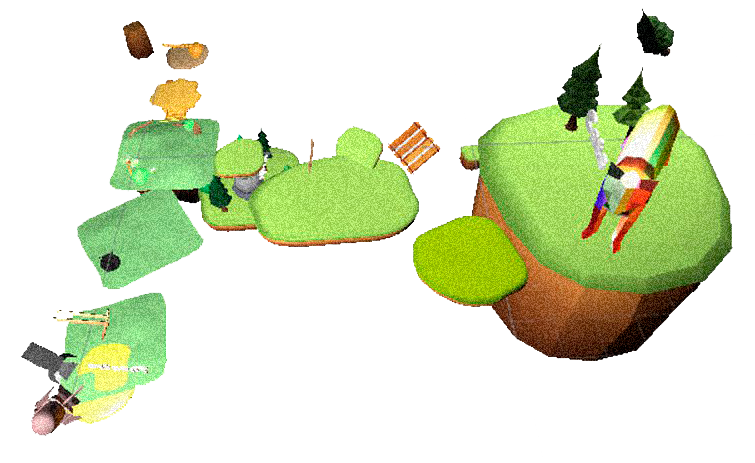
Parts of the main "HUB"
Screenshot from the main menu with a russian name for the project "VстRеча" (meeting).
Interactive 360-photo, highlighted objects lead to 360-video scene with relating parts of the interview
Location with "find all the cats" minigame. While exploring, the player listens to stories about them narrated by the interview subject. Stepping inside a 360-sphere allows to see a video.
The current version is a demonstration prototype rather than a finished product – it requires a Bluetooth keyboard connected to a phone with a gyroscope, which limits accessibility. The project was built in Unity using 360° video and photography as the primary spatial material, with audio stories triggered by interaction. The environments were designed around the interviewee's actual images, spaces, and narratives rather than constructed fictional settings.


